The inability to think hierarchically is the ability to think and live relationally
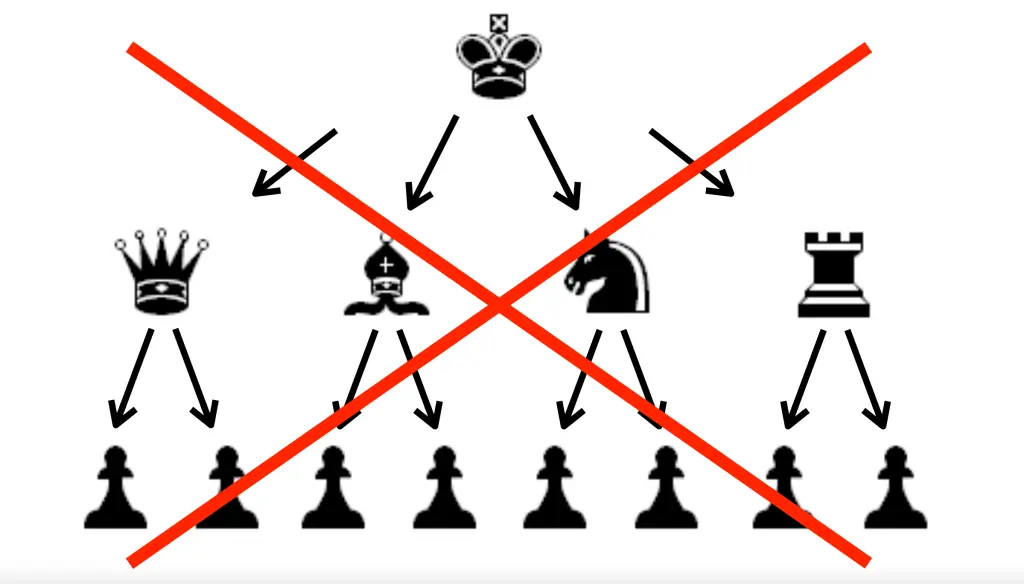
Many Autistic people have great difficulties to think of the world in hierarchical ways. From what we know about our evolutionary path as humans, this is a reflection of innate human collaborative cultural capabilities in combination with a much reduced capacity for maintaining cognitive dissonance on an ongoing basis, which in turn can be traced to uncommon sensitivity profiles that fall outside the bell curve of hypernormativity.
When Autists learn about the social expectations that are attached to participating in and operating in hierarchically organised structures of social power, we have difficulty comprehending that such structures are considered acceptable. We are consciously aware of the pain and the potential we harm we can cause by exerting social power over others, as well the pain and cognitive dissonance that we experience when authorities impose arbitrarily demands on us that are incompatible with our unique individual sensitivity profiles.
Within the cultural frame of internalised ableism, the Autistic reluctance to exert social power over others is interpreted as a social deficit, i.s. as an inability to be entrusted with so called “leadership” responsibilities, and at the same time, the Autistic reluctance to submit to arbitrary social power is interpreted as a social deficit, i.e. as non-compliance, as disagreeableness, and as disrupting the “natural” social order.
This explains why in the context of some concrete social situations Autistic people are dismissed as being “weak or incompetent leaders”, and in other social contexts and situations the same Autistic people are dismissed and punished for being “aloof, arrogant, insensitive, and inappropriately competitive”. In many cases, both conclusions are completely misguided.
...
Autistic culture
In recent years, thanks to innate reluctance or inability to participate in social games, Autistic people have shifted and are increasingly shifting towards genuinely human-scale online spaces for cosmolocal community co-creation, peer support, and egalitarian relationship building on Autistic terms, beyond the influence of the dominant culture of Homo Economicus®.
The Autistic inability to think hierarchically turns out to be the ability to think and live entirely relationally. We see this in the level of interest and growing participation in the human scale Ecologies of Care support model, and in the growing worldwide interest in the egalitarian NeurodiVenture worker coop model for engaging with the external social world.
In the hypernormative culture that dominates the modern world, it is hard to explain to non-Autistic people what the immersion in healthy Autistic culture feels like and what the development of healthy sacred lifetime relationships between Autistic people feels like. In mainstream society people don’t understand how Autistic people support each other, love each other, and care for each other in ways that go far beyond the culturally impaired neuronormative imagination.